
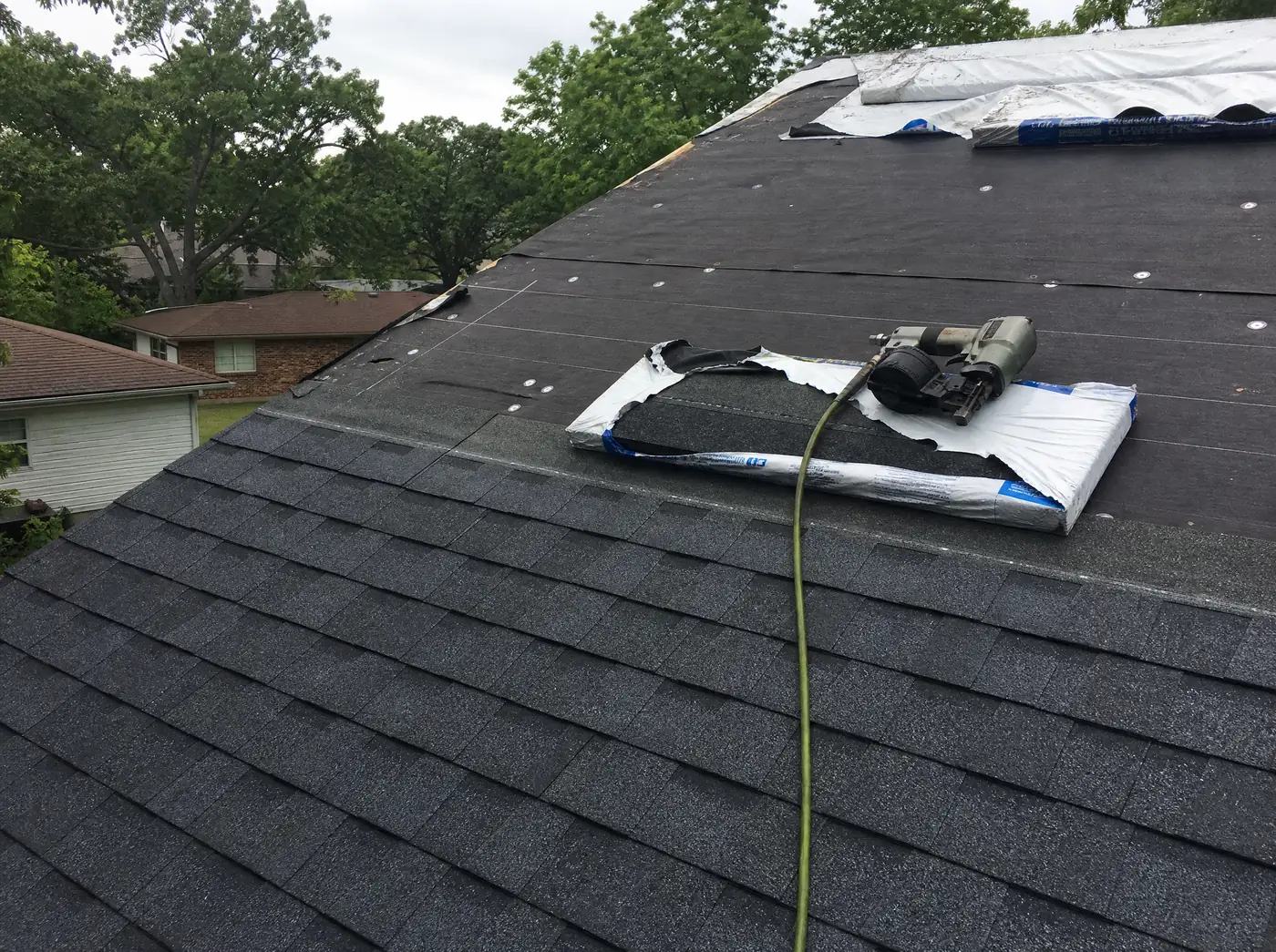
The three grades, and which one belongs on a Springfield house
Three-tab
Flat, single-layer, the classic repeating rectangle. Cheapest to buy and cheapest to install, typically rated to 60 mph wind and lasting 14 to 18 years here. We install it on rentals, outbuildings, garages and detached shops. We talk almost everybody out of it on a house, and the reason is specific to this county rather than snobbery: a three-tab has one layer of mat between a hailstone and your decking.
Architectural (dimensional, laminate)
Two laminated layers, a shadow line that reads as depth from the street, typically 110 to 130 mph wind ratings and 18 to 22 real years in the Ozarks. This is the default and it is what goes on most of what we do. The manufacturers print 30 and 50 year figures on the wrapper. Those come from a laboratory, and the Ozarks are not one.
Class 4 impact-resistant
Architectural construction with a modified, more flexible mat, tested by dropping a two inch steel ball on it from twenty feet without the mat fracturing. Ten to twenty percent more than standard architectural. In this county it usually pays for itself, and not through longevity.
Most Missouri carriers give a premium credit for a Class 4 roof, commonly five to fifteen percent on the wind and hail portion. Across an eighteen to twenty-two year roof that credit frequently exceeds the upgrade cost on its own. What Class 4 will not do is survive four inch hail; nothing residential does. What it does is turn the 1.5 and 2 inch storms, which is what we actually get most years, into a non-event rather than a claim. Ring your agent, ask what the credit is on your policy specifically, then decide.
| Work | Typical Springfield range | What moves it |
|---|---|---|
| Three-tab | $175 – $280 per square | Rentals and outbuildings; not a house here |
| Architectural / dimensional | $300 – $450 per square | The default |
| Class 4 impact-resistant | $350 – $550 per square | 10–20% over architectural, often offset by the premium credit |
| 2,000 sq ft house, architectural | $8,500 – $13,400 | Complete tear-off |
| Designer / luxury profiles | $500 – $750 per square | Slate and shake look-alikes |
One square is 100 square feet. A 2,000 square foot roof is 20 squares plus waste.
The lines we install, and where the money goes
We are not tied to one manufacturer, which means we have no reason to steer you.
- GAF Timberline HDZ and the Class 4 Timberline AS II. HDZ is the most-installed architectural shingle in the country and its LayerLock nailing zone genuinely is more forgiving of a crew having a bad afternoon, which matters more than the marketing suggests.
- Owens Corning Duration with the SureNail strip, and Oakridge at the lighter end. The Duration’s reinforced nailing band is the same idea as GAF’s and it works.
- CertainTeed Landmark and the Class 4 Landmark IR. Landmark is a heavier shingle than most of its price bracket.
- IKO Dynasty and Cambridge. Good value, and the ArmourZone nailing band puts it in the same conversation as the two above.
- Tamko Titan XT. Made in Joplin, about seventy miles down I-44, which some customers care about and is also why supply is reliable here when it is tight elsewhere.
- Atlas Pinnacle Pristine with Scotchgard, which does actually slow the black algae streaking that shows up on north slopes around here.
- Malarkey Legacy and Vista, rubberised with recycled polymer, Class 4 across much of the range and the most genuinely hail-tolerant asphalt we install.
What you are actually paying for, layer by layer
The shingle is the part you can see and roughly a third of what a good roof costs. The rest is the assembly underneath, and it is where cheap quotes make their money.
- Decking. Usually half-inch OSB or plywood. Inspected sheet by sheet after tear-off, replaced where it is soft, at a per-sheet price you were told in advance.
- Drip edge. Metal at the eaves and rakes. Required by code, routinely left off cheap jobs, and the thing that stops water wicking back under the edge.
- Ice-and-water shield. Self-adhering membrane at eaves, valleys and every penetration. Southwest Missouri freeze-thaw makes eave protection worth having.
- Synthetic underlayment. Across the whole field. Not felt. This is the layer that keeps your ceiling dry on the day a shingle fails.
- Starter course. Purpose-made starter strip at eaves and rakes, not cut-up shingles. It carries the wind rating at the most vulnerable edge and it is the second most commonly skipped item after drip edge.
- Flashing. New step, counter, apron and valley metal. New boots. Reusing old flashing is how a new roof leaks in year two.
- The field shingles, six nails per shingle here, not four, because of our wind.
- Hip and ridge cap plus ridge vent. Purpose-made cap, not folded field shingle, and exhaust ventilation matched to the soffit intake.
Colour, since everybody asks last and thinks about it most
Weathered wood, driftwood and barkwood dominate around here for a reason: they hide the granule irregularity that any roof develops and they suit the brick and stone that Springfield builds in. Charcoal and onyx black look sharp on white or pale grey siding and run hotter in a Missouri July, which matters more if your attic ventilation is poor. Lighter greys and weathered wood tones stay cooler. If your house is under an HOA in Battlefield or one of the newer Republic subdivisions, check the approved palette before you fall in love with something.
We do this work outside Springfield too
Same crews, same trucks, same price book. Pick your town and we will tell you what the April 28, 2026 storm actually did there.
- Republic Asphalt Shingles
- Asphalt Shingles in Willard
- Asphalt Shingles for Aurora homes
- Battlefield Asphalt Shingles
- Asphalt Shingles in Ash Grove
- Asphalt Shingles for Clever homes
- Fair Grove Asphalt Shingles
- Asphalt Shingles in Nixa
- Asphalt Shingles for Ozark homes
- Marshfield Asphalt Shingles
- Asphalt Shingles in Rogersville
- Asphalt Shingles for Strafford homes
- Bolivar Asphalt Shingles
- Asphalt Shingles in Branson
Questions about asphalt shingles
What is the best shingle for hail in Springfield?
Malarkey Legacy, GAF Timberline AS II and CertainTeed Landmark IR are the three we reach for, all Class 4. Malarkey’s rubberised mat is the most genuinely impact-tolerant asphalt we install. None of them survive four inch hail, and anybody telling you otherwise is selling.
How long do shingles really last here?
18 to 22 years for architectural, 14 to 18 for three-tab, regardless of the number on the wrapper. The variables that actually decide it are attic ventilation, how many hail events you catch, and whether the installation details were right on day one.
Do I really need six nails per shingle?
In this wind, yes. Four is the minimum in the manufacturer’s low-wind instruction and six is what the high-wind spec requires, which is also what most warranties are conditioned on. It costs a few dollars of nails and about twenty minutes.
What is the black streaking on my north slope?
Gloeocapsa magma, an algae. It is cosmetic and it does not shorten the roof, though it does make it look a decade older than it is. Algae-resistant shingles with copper granules, or a zinc strip at the ridge, slow it. Do not pressure wash an asphalt roof, it removes the granules.
Can you install over my existing shingles?
We do not. See the overlay section on the replacement page for the four reasons.
Related work we do
- Roof Replacement & Tear-Off
- Metal Roofing & Standing Seam
- Roof Ventilation & Underlayment
- Storm & Hail Damage Roof Repair
Or start at the Springfield roofing contractors homepage if you are still working out what you need.