
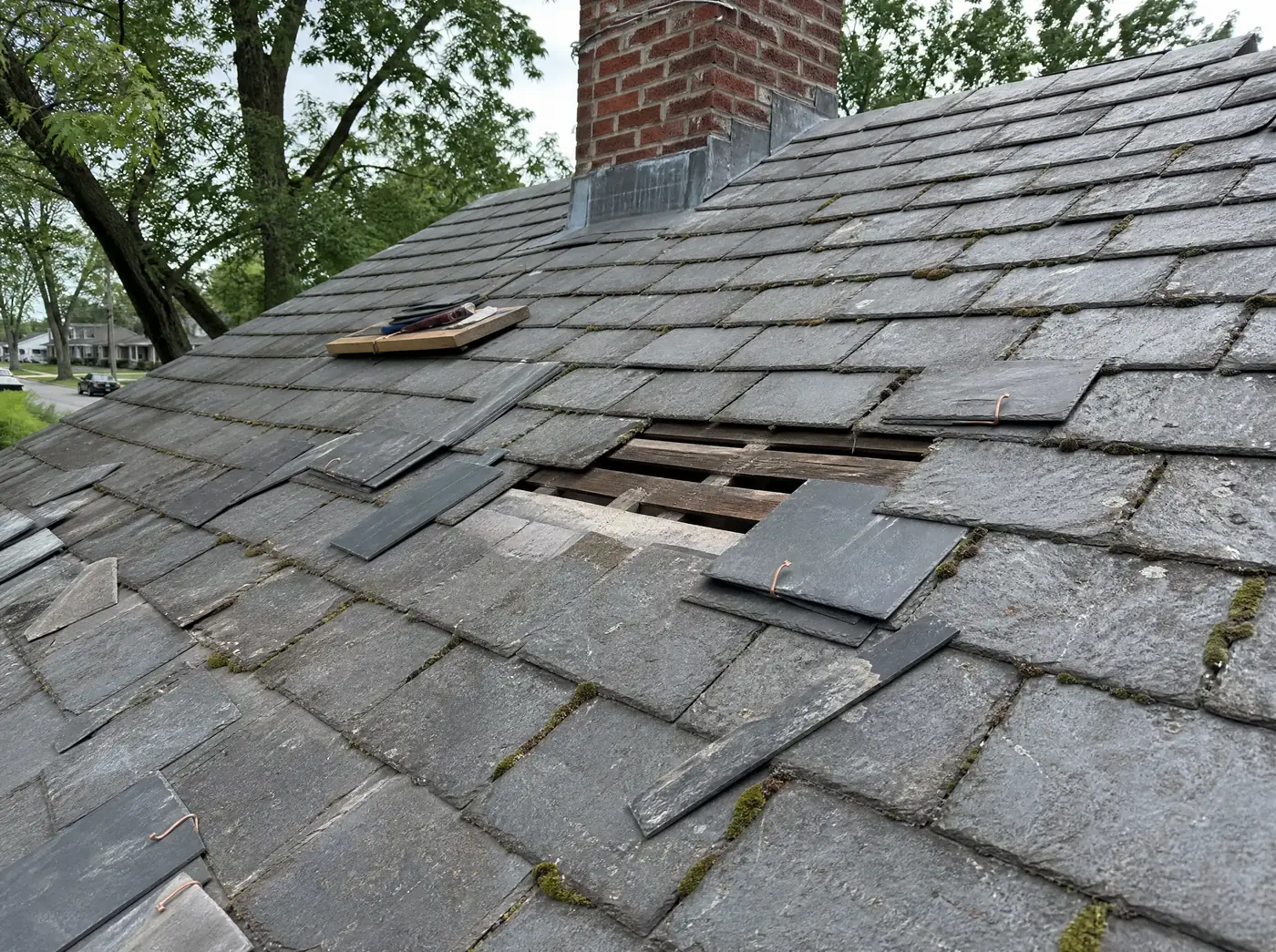
The first conversation on any hundred-year-old roof is not about materials, it is about weight. Real slate runs 800 to 1,500 pounds per square. Asphalt is 200 to 350. If a slate roof was replaced with asphalt at some point and you want to go back, the structure is the question, and it needs looking at before anything else gets discussed. That is a free visit and it is worth having before you get attached to an idea.
Real slate
Properly installed slate lasts 75 to 150 years, which means the roof usually outlives everything fixed to it. What fails first is almost never the slate itself: it is the flashing, the fasteners and the underlayment. A slate roof that is "failing" is very often a slate roof with rusted nails and dead valley metal, and that is a restoration rather than a replacement.
- Individual slate replacement with a slate ripper and a copper hook or bib. Never with roofing cement, which is what somebody has usually already done to yours.
- Valley and flashing replacement, which is the actual life-limiting component on most slate roofs. Copper, done once.
- Re-nailing and re-laying where the fasteners have corroded but the slate is sound. The slate is salvaged and reused.
- Full replacement where the slate has genuinely delaminated, which shows as flaking, softness and a dull sound when tapped rather than a ring.
The most important thing we can tell you about a slate roof: keep people off it. Slate breaks under a boot. Half the broken slates we replace were broken by somebody servicing a chimney, an aerial or a satellite dish. If work has to happen up there, it happens off a ladder hook or a properly spread plank.
Cedar shake and shingle
Cedar shingles are sawn and uniform; shakes are split and rugged. Both are beautiful and both are a commitment. In this climate, expect 20 to 30 years for shingles and 25 to 40 for a good heavy shake, and only with maintenance. Missouri humidity is the enemy: moss and algae on north slopes, cupping and splitting where the roof cannot breathe.
- Ventilation underneath matters more than on any other roof. Cedar has to dry from both faces. A shake roof laid straight onto solid decking without a breather mat traps moisture and rots from underneath.
- Treated versus untreated. Pressure-treated cedar with fire retardant and preservative costs more and lasts materially longer here.
- Cleaning and treatment every few years, gently. Never a pressure washer, which drives water into the wood and tears the surface fibres.
- Fire rating. Untreated cedar is Class C at best. Treated assemblies reach Class A or B, and some insurers and some subdivisions will not accept untreated cedar at all. Check before you commit.
Synthetic slate and composite shake, which is what most people choose
Honestly, this is where most of these conversations end up, and for good reasons. Moulded polymer or rubber composite products that take a real cast from real slate or split cedar, at a fraction of the weight, with a Class 4 impact rating and a 50 year warranty. In a county that recorded 4.75 inch hail this April, a Class 4 rating is not a footnote.
- Weight: 250 to 400 pounds per square against slate’s 800 to 1,500. It goes on standard framing with no structural work.
- Impact: Class 4 across most of the range, and it flexes rather than shattering.
- Cost: substantially less than real slate, more than architectural asphalt.
- Appearance: genuinely convincing at street distance, and increasingly so close up. The good products vary thickness and colour across the batch precisely so it does not read as a repeating pattern.
- Installation: conventional roofing skills, so you are not dependent on one specialist crew for every future repair.
The honest downside is that it is not slate, and on a genuinely historic house where the roof is part of the architecture, that matters to some owners. That is a legitimate position and we will quote the real thing if that is what you want.
| Work | Typical Springfield range | What moves it |
|---|---|---|
| Individual slate replacement | $25 – $60 per slate | Access and matching drive it |
| Slate valley and flashing restoration | By quote | Usually the real fix |
| Real slate, full replacement | $1,200 – $2,500 per square | Plus any structural work |
| Cedar shingle | $700 – $1,100 per square | Treated costs more, lasts longer |
| Cedar shake, heavy split | $900 – $1,500 per square | |
| Synthetic slate | $650 – $1,100 per square | Class 4, 50 year warranty |
| Composite shake | $600 – $1,000 per square | Class 4 |
| Cedar cleaning and treatment | $500 – $1,400 | Gentle wash, never pressure |
One square is 100 square feet. These are specialist materials and the ranges are wide because access, pitch and matching matter more than on an asphalt job.
Historic houses in Springfield
If your house sits in one of the older districts, check whether there are any local requirements on visible materials before you order anything, and check your insurer as well. Some carriers will not write untreated cedar. And on any house of that age, the ventilation and the decking are as much of the job as the covering: nobody put a ridge vent on in 1912, and a hundred-year-old deck often has boards rather than sheet material, which changes how everything fastens.
We do this work outside Springfield too
Same crews, same trucks, same price book. Pick your town and we will tell you what the April 28, 2026 storm actually did there.
- Republic Cedar Shake & Slate
- Cedar Shake & Slate in Willard
- Cedar Shake & Slate for Aurora homes
- Battlefield Cedar Shake & Slate
- Cedar Shake & Slate in Ash Grove
- Cedar Shake & Slate for Clever homes
- Fair Grove Cedar Shake & Slate
- Cedar Shake & Slate in Nixa
- Cedar Shake & Slate for Ozark homes
- Marshfield Cedar Shake & Slate
- Cedar Shake & Slate in Rogersville
- Cedar Shake & Slate for Strafford homes
- Bolivar Cedar Shake & Slate
- Cedar Shake & Slate in Branson
Questions about cedar shake & slate
Can my house take a real slate roof?
Depends entirely on the framing. Slate is three to five times the weight of asphalt, and if a previous owner converted from slate to shingle the structure may no longer be carrying what it once did. This gets checked before anything else. Synthetic slate sidesteps the question completely.
How do I know if my slate is dying or just needs repair?
Tap it. Sound slate rings; delaminating slate thuds. Look for flaking at the exposure, slates that have gone soft at the edges, and how many are already missing or cemented in place. If the slate is sound and the flashing is finished, you have a restoration, not a replacement, and that is a much better afternoon.
Is cedar a bad idea in Missouri humidity?
Not a bad idea, a demanding one. It needs to breathe on both faces, which means a breather mat or skip sheathing rather than solid decking, and it needs cleaning and treating on a schedule. Do those and it is a 25 to 40 year roof. Skip them and it is fifteen.
Will synthetic slate look fake?
Not from the street, and increasingly not up close. The good products are cast from real slate and vary thickness and colour deliberately so they do not repeat. Come and look at a sample in daylight rather than deciding from a website photograph.
Do you clean and treat cedar roofs?
Yes, gently. Soft wash, appropriate treatment, moss removal by hand where needed. Never a pressure washer: it drives water into the wood and tears the surface fibres, and it takes years off the roof.
Related work we do
- Asphalt Shingle Roofing
- Roof Replacement & Tear-Off
- Roof Repair & Leak Repair
- Roof Maintenance & Coatings
Or start at the Springfield roofing contractors homepage if you are still working out what you need.