
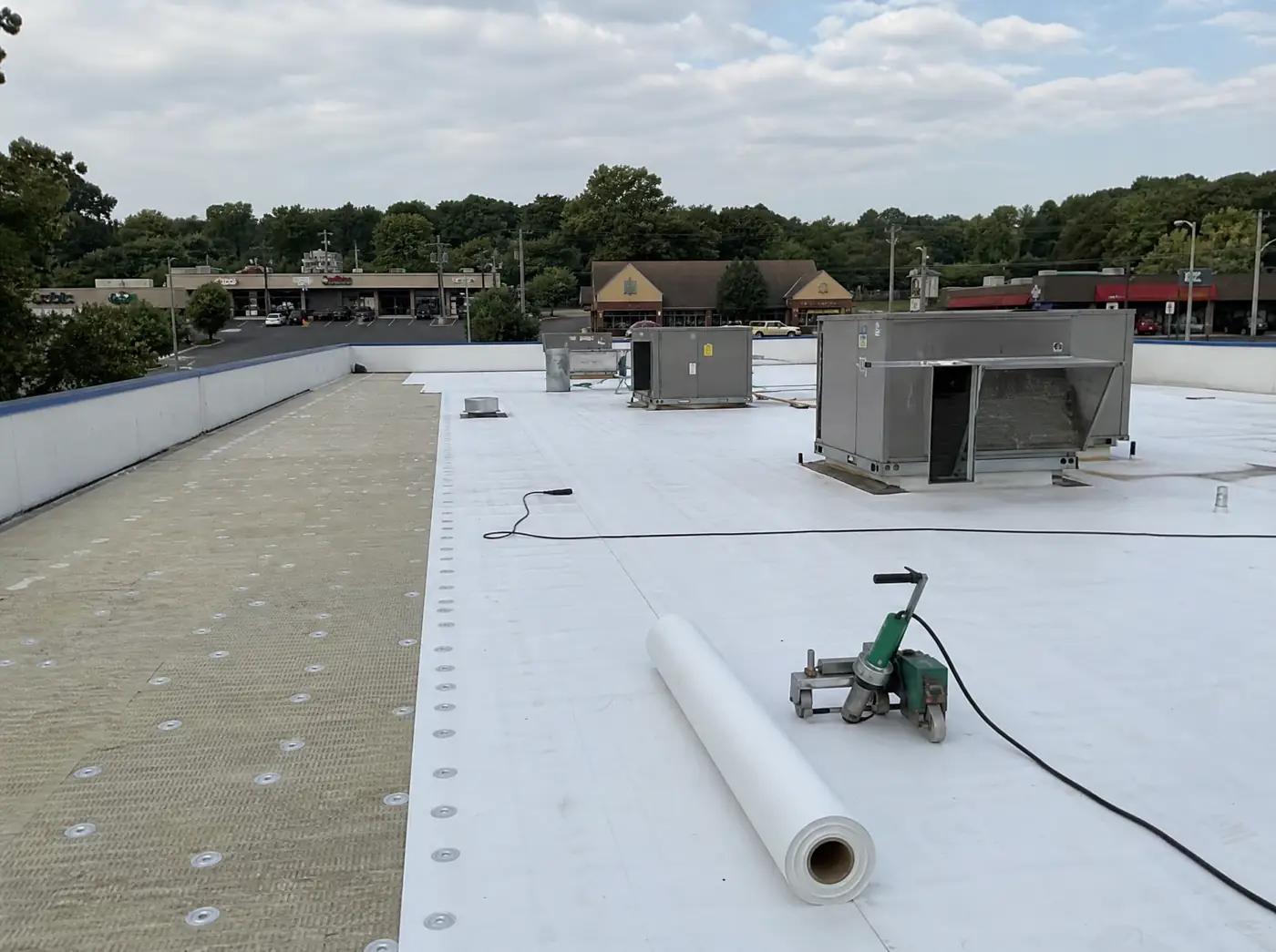
A property manager rang us in June about a strip centre off Sunshine with four tenants and one persistent leak that three contractors had chased over two years. It was not a membrane failure. It was a condensate line from a rooftop unit discharging onto the deck twelve feet from where the water appeared inside. That is commercial roofing: the roof is a system with a dozen other trades bolted to it, and half of what looks like a roof leak is not one.
The systems we work in
TPO
Single-ply thermoplastic, heat-welded seams, usually white. The default for new low-slope commercial work now and the most common thing we install. The white surface reflects heat, which is worth real money on a Missouri August cooling bill. Its weak point is seam quality, so it lives or dies on the welder’s competence and on somebody actually probe-testing the seams afterwards. 20 to 30 years installed properly.
EPDM
Rubber membrane, black or white, seams taped or glued rather than welded. Been in the market since the 1960s so its failure modes are extremely well understood, which is a genuine advantage. Very tolerant of thermal movement and of building settlement. Black EPDM absorbs heat, which is a liability in summer and an asset for shedding snow. 20 to 30 years.
PVC
The chemical-resistant option and the one that belongs over kitchens. Restaurant grease exhaust destroys TPO and EPDM; PVC shrugs at it. More expensive, hot-air welded, excellent for restaurants, food processing and anywhere with animal fat or solvent in the exhaust stream.
Modified bitumen
Asphalt-based sheet in two or three plies, torch, hot-mopped or self-adhered. Tough underfoot, good where there is heavy rooftop traffic or a lot of equipment, and very repairable. Common on older Springfield buildings and often the sensible match when you are patching into an existing mod-bit field.
Built-up (tar and gravel)
The old multi-ply hot asphalt system with gravel ballast. We rarely install it new and we maintain a lot of it downtown. If you have one that is functioning, a coating restoration is usually a better use of money than a tear-off.
Coating restoration
Silicone or acrylic applied over a sound but ageing membrane. Where the existing roof is dry and structurally fine, this buys ten to fifteen years for a fraction of a replacement, and it is often a capital expense your accountant would rather see. It does not fix a wet roof. If the insulation is saturated, coating over it just traps it, and we will tell you that after we core it rather than sell you the cheaper job.
| Work | Typical Springfield range | What moves it |
|---|---|---|
| TPO, fully adhered or mechanically attached | $6.50 – $11 per sq ft | Insulation thickness, deck type, tear-off |
| EPDM | $6 – $10 per sq ft | Ballasted is cheaper, adhered costs more |
| PVC | $8 – $13 per sq ft | The right call over kitchen exhaust |
| Modified bitumen, 2-ply | $7 – $12 per sq ft | Traffic-tolerant |
| Silicone coating restoration | $2.50 – $5 per sq ft | Only over a dry, sound membrane |
| Tear-off and disposal | $1.50 – $3.50 per sq ft | Per existing layer |
| Core sample and condition report | Free on a quote | Photographed and patched |
Commercial numbers move on access, deck type, code-required insulation and how many layers are already up there. Nobody can quote one from an address.
What we look at before quoting anything
- Core samples. Cut, examined, photographed and patched. We need to know how many roofs are already up there, what the insulation is, whether it is wet, and what the deck is. Quoting a commercial roof without coring it is guessing with your money.
- Drainage. Where the water goes, whether the drains and scuppers are sized and clear, and where it ponds. Standing water 48 hours after rain is a design problem, not a membrane problem.
- Penetrations and curbs. Rooftop units, exhaust fans, hatches, skylights, pipe stands, satellite mounts. This is where commercial roofs actually leak.
- Edge metal and parapets. Coping, counterflashing, through-wall flashing. Wind uplift starts at the edge.
- Structure and code. How many layers can legally stay, whether the deck will carry an overlay, and what current energy code requires for insulation R-value on a full replacement. That last one surprises owners and it belongs in the budget early.
Working around a business that is still trading
Nobody is jackhammering a parapet over your dining room at noon. We phase work by section so tenants keep operating, schedule tear-off away from your busy hours, keep dumpsters and material staging out of customer parking, and protect the interior at every penetration we open. For occupied medical and childcare buildings we work out odour and noise timing in advance, because torch-applied and solvent-based products are a genuine problem in those settings and there are alternatives.
Budget planning, not just emergencies
The most useful thing we do for property managers is not the tear-off, it is the written condition assessment across a portfolio: what each roof is, its age, its remaining service life, what it will cost, and which year to put it in the capital plan. Then a twice-yearly maintenance visit keeps small things small. A $900 flashing repair caught in spring is a $40,000 deck replacement avoided in three years, and that arithmetic is the entire argument for the maintenance programme.
We do this work outside Springfield too
Same crews, same trucks, same price book. Pick your town and we will tell you what the April 28, 2026 storm actually did there.
- Republic Commercial Roofing
- Commercial Roofing in Willard
- Commercial Roofing for Aurora homes
- Battlefield Commercial Roofing
- Commercial Roofing in Ash Grove
- Commercial Roofing for Clever homes
- Fair Grove Commercial Roofing
- Commercial Roofing in Nixa
- Commercial Roofing for Ozark homes
- Marshfield Commercial Roofing
- Commercial Roofing in Rogersville
- Commercial Roofing for Strafford homes
- Bolivar Commercial Roofing
- Commercial Roofing in Branson
Questions about commercial roofing
How long will a commercial roof last in Springfield?
20 to 30 years for a properly installed and maintained TPO, EPDM or PVC. The gap between the good and bad end of that range is almost entirely maintenance and drainage, not brand. A roof with clear drains and an annual inspection outlives an identical one that nobody visits by a decade.
Can we overlay instead of tearing off?
Sometimes. Code generally allows a second roof but not a third, and the existing assembly has to be dry and the deck sound enough to carry it. A core sample answers this in an afternoon. If the insulation is saturated, an overlay traps the water and you have bought a slower failure.
Do you handle hail damage on commercial buildings?
Yes, and April was hard on flat roofs in the northwest quadrant. Hail on a single-ply membrane creates fractures in the sheet that are not visible from a standing height and are obvious on your knees with low-angle light. Documentation matters even more than on residential because the numbers are larger.
What about roof access for our HVAC contractor?
We install walk pads on the traffic routes as part of any new membrane, and if you do not have them now we can add them. Most premature single-ply failure we see around here is somebody’s toolbox and boot heels on an unprotected field.
Can you work at night or on weekends?
Yes, on retail and restaurant work particularly. It costs more per hour and it usually costs less overall than closing.
Related work we do
- Flat & Low-Slope Roof Repair
- Metal Roofing & Standing Seam
- Roof Maintenance & Coatings
- Roof Inspection & Written Estimate
Or start at the Springfield roofing contractors homepage if you are still working out what you need.