
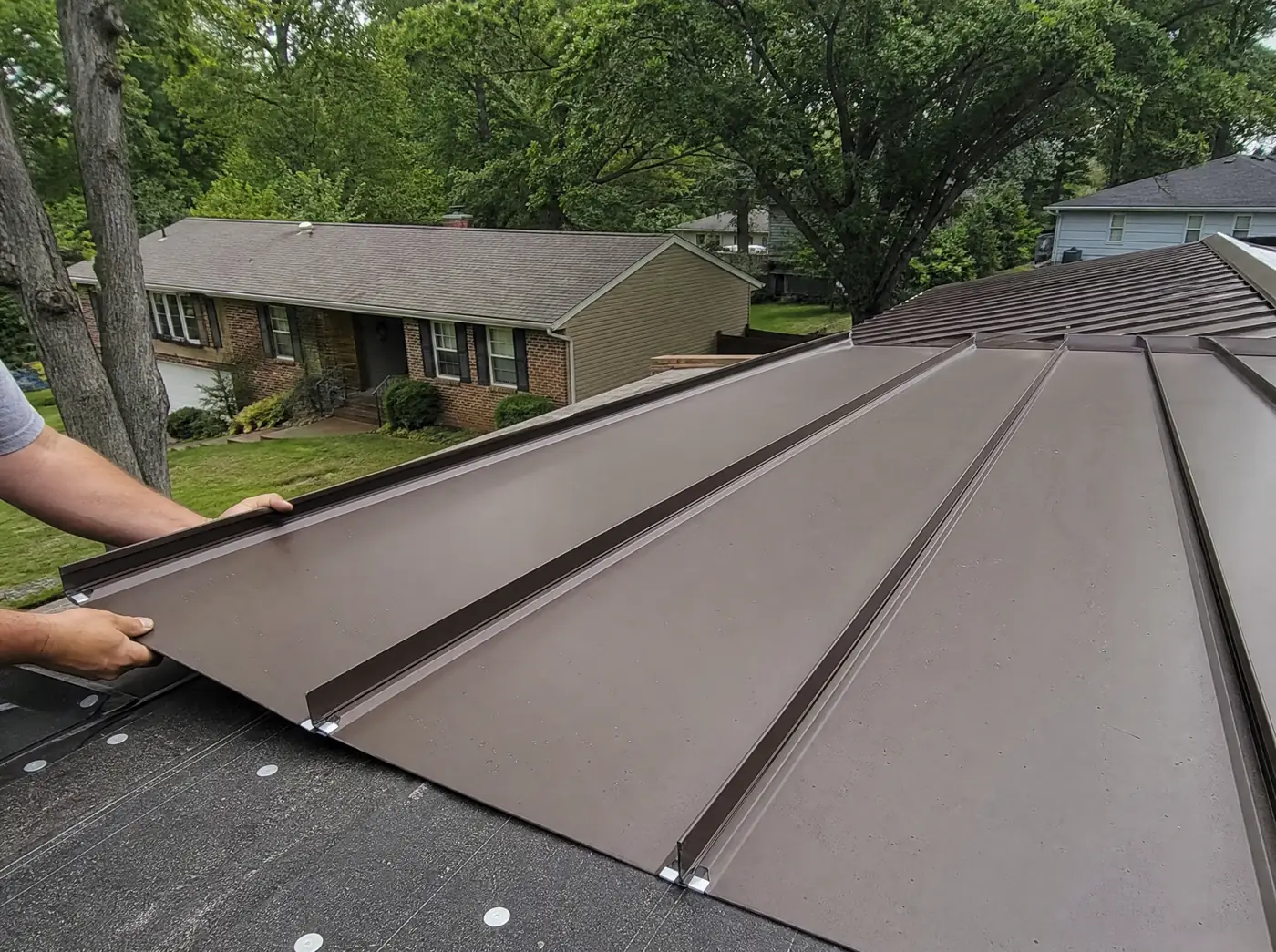
The half of the metal-and-hail answer nobody prints
The good half first, and it is genuinely good. A properly installed standing seam roof will outlive two or three asphalt roofs, shrugs off the 1.5 inch hail that ruins shingles, carries a Class A fire rating and a 140 mph-plus wind rating, and sheds the wet snow that sits on a low-pitch shingle roof all February.
The other half: metal dents. A 24 gauge steel panel will take cosmetic denting from about 1.75 inch hail upwards, and in 4.00 inch hail like Willard and Bois D’Arc caught on April 28, 2026 it will look like a golf ball. The panel is still watertight. It has not failed. It is just ugly, and that is precisely the argument you are then going to have with an adjuster, because many policies now carry a cosmetic damage exclusion on metal roofs which lets the carrier decline to pay for denting that does not affect function.
If you are putting metal on because of hail, ring your insurer first and ask two questions. Does the policy contain a cosmetic damage exclusion for metal roofing? And is there a premium credit for a metal or Class 4 roof? The answers change the maths completely, and they are different at every carrier. Any roofer who does not raise this with you either does not know or is not saying.
The two families of metal roof
Standing seam (concealed fastener)
Panels run from ridge to eave and lock together at a raised vertical seam, with the clips hidden underneath. No fastener penetrates the weather surface, which is why it lasts: there are no rubber washers ageing in the sun waiting to leak. Snap-lock is the common residential system, mechanically seamed is for low pitches and commercial. This is what people mean when they say "metal roof" and want it on the front of the house.
Exposed fastener (R-panel, corrugated, 5V)
Screwed through the face with a neoprene-washered screw. A fraction of the cost, faster to install, and everywhere on shops, barns, carports and porch roofs across Greene, Polk and Webster counties. The washers are the service item: plan on re-screwing at fifteen to twenty years. We are happy to put it on a shop or a barn. We will push back on putting it on the front of your house.
| Work | Typical Springfield range | What moves it |
|---|---|---|
| Exposed fastener panel (R-panel, corrugated) | $4 – $7 per sq ft | Shops, barns, carports, porches |
| Standing seam, 24ga steel | $9 – $14 per sq ft | The residential default |
| Standing seam, 2,000 sq ft house | $16,000 – $24,000 | Panel gauge, seam type, roof complexity |
| Stone-coated steel | $11 – $16 per sq ft | Hides denting; shake or tile look |
| Aluminium standing seam | $12 – $18 per sq ft | Will not rust, dents easier |
| Copper | $20 – $40 per sq ft | Accents and bay roofs, mostly |
| Snow guards | $8 – $18 per linear ft | Over doors, drives and meters |
Metal costs roughly twice asphalt up front and lasts roughly three times as long, so the lifetime maths favours it if you are staying put. If you are moving in five years it usually does not.
Profiles and materials, briefly
- Galvalume steel, 24 or 26 gauge, aluminium-zinc coated. The default here. 24 gauge is stiffer and dents less; it is worth the upgrade in this county.
- Aluminium. Will not rust at all, lighter, dents more easily than steel. Worth it near constant moisture; rarely necessary inland.
- Stone-coated steel. Steel panel with a granulated finish that looks like shake or tile, and the coating hides denting far better than a smooth panel. Genuinely worth considering in a hail market.
- Metal shingles and shakes. Interlocking panels that read as shingle from the street. Aluminium or steel, good for HOA areas that will not approve a standing seam look.
- Copper. Beautiful, $20 to $40 a square foot, and around here mostly a bay window or a porch roof rather than a whole house.
Details that decide whether a metal roof is any good
Metal is far less forgiving of a mediocre installer than shingle is. Shingles hide sins. Metal displays them for thirty years.
- Thermal movement. A 30 foot steel panel grows and shrinks measurably across a Missouri year. Clips have to allow it. Fix a panel rigidly at both ends and it will oil-can, or tear its own fastener holes.
- Underlayment. High-temperature synthetic, because the cavity under metal runs hot enough to cook a standard membrane and standard felt.
- Panel length and site forming. Full-length panels ridge to eave with no transverse seam is what you want, which means roll-forming on site for anything over about twenty feet.
- Snow guards. Metal sheds snow in one go, in a slab. Over a doorway, a driveway or a gas meter, that needs guards. Springfield does not get much snow, and when it does it tends to be the heavy wet kind that comes off hard.
- Trim and flashing. Ridge, hip, rake, eave, valley and every penetration needs purpose-made trim. Caulk is not a flashing detail on a metal roof.
Metal over shingles: sometimes fine, often not
You will see it offered, usually with a batten or purlin system over the existing roof. It is faster and cheaper and it can be done properly. Our two conditions are that the existing roof is one layer, flat, and dry with sound decking underneath, and that the structure will carry the extra load. If the shingles underneath are cupped, wet or doubled, you are building a good roof on a bad foundation and hiding a problem you will pay for later.
We do this work outside Springfield too
Same crews, same trucks, same price book. Pick your town and we will tell you what the April 28, 2026 storm actually did there.
- Republic Metal Roofing
- Metal Roofing in Willard
- Metal Roofing for Aurora homes
- Battlefield Metal Roofing
- Metal Roofing in Ash Grove
- Metal Roofing for Clever homes
- Fair Grove Metal Roofing
- Metal Roofing in Nixa
- Metal Roofing for Ozark homes
- Marshfield Metal Roofing
- Metal Roofing in Rogersville
- Metal Roofing for Strafford homes
- Bolivar Metal Roofing
- Metal Roofing in Branson
Questions about metal roofing
Will a metal roof survive Springfield hail?
Functionally, almost always. Cosmetically, not above about 1.75 inch. A 4.00 inch storm like Willard caught in April dents 24 gauge steel visibly and the panel stays watertight. Whether your insurer pays to replace a dented but working roof depends entirely on whether your policy has a cosmetic damage exclusion.
Is a metal roof loud in the rain?
Not over a house. The noise people remember is from a barn, where the panel is screwed to open purlins with air underneath. Over solid decking, underlayment and attic insulation it measures about the same as asphalt. Most people notice it slightly the first week and never again.
Does metal attract lightning?
No. Lightning is not attracted to metal, it goes to the tallest path to ground. If you are struck, a metal roof is safer than shingle, because it distributes the energy and does not burn.
Can you put metal on a low-slope or flat roof?
Mechanically seamed standing seam goes down to about 1:12 or 2:12 depending on the system. Snap-lock and exposed-fastener panel want 3:12 and up. Below 1:12 you want a membrane, which is the flat roof page.
Will metal make my house hotter?
Cooler, if anything. Painted metal reflects a large share of solar radiation and, on a batten system, the air gap underneath helps further. The colour matters more than the material.
Related work we do
- Roof Replacement & Tear-Off
- Asphalt Shingle Roofing
- Commercial & Industrial Roofing
- Roof Maintenance & Coatings
Or start at the Springfield roofing contractors homepage if you are still working out what you need.