
Flat roofs are not just a commercial problem here
Springfield’s mid-century housing is full of them and most owners do not think of them as roofs at all. Sunroom and family-room additions from the sixties and seventies, carport and porch roofs, the flat section over a rear extension, dormer tops, and the low-slope tie-in where an addition meets the main pitched roof. Rountree, Phelps Grove, University Heights and the older streets around Drury are full of exactly this, and the tie-in junction is where they leak, every time.
Nothing built is truly flat. What people call a flat roof is a low-slope roof, pitched at a quarter inch per foot or less so water moves rather than sits. When it stops moving, either the structure has deflected or the drainage was never right, and that is a different repair from patching a seam.
What actually goes wrong
Ponding water
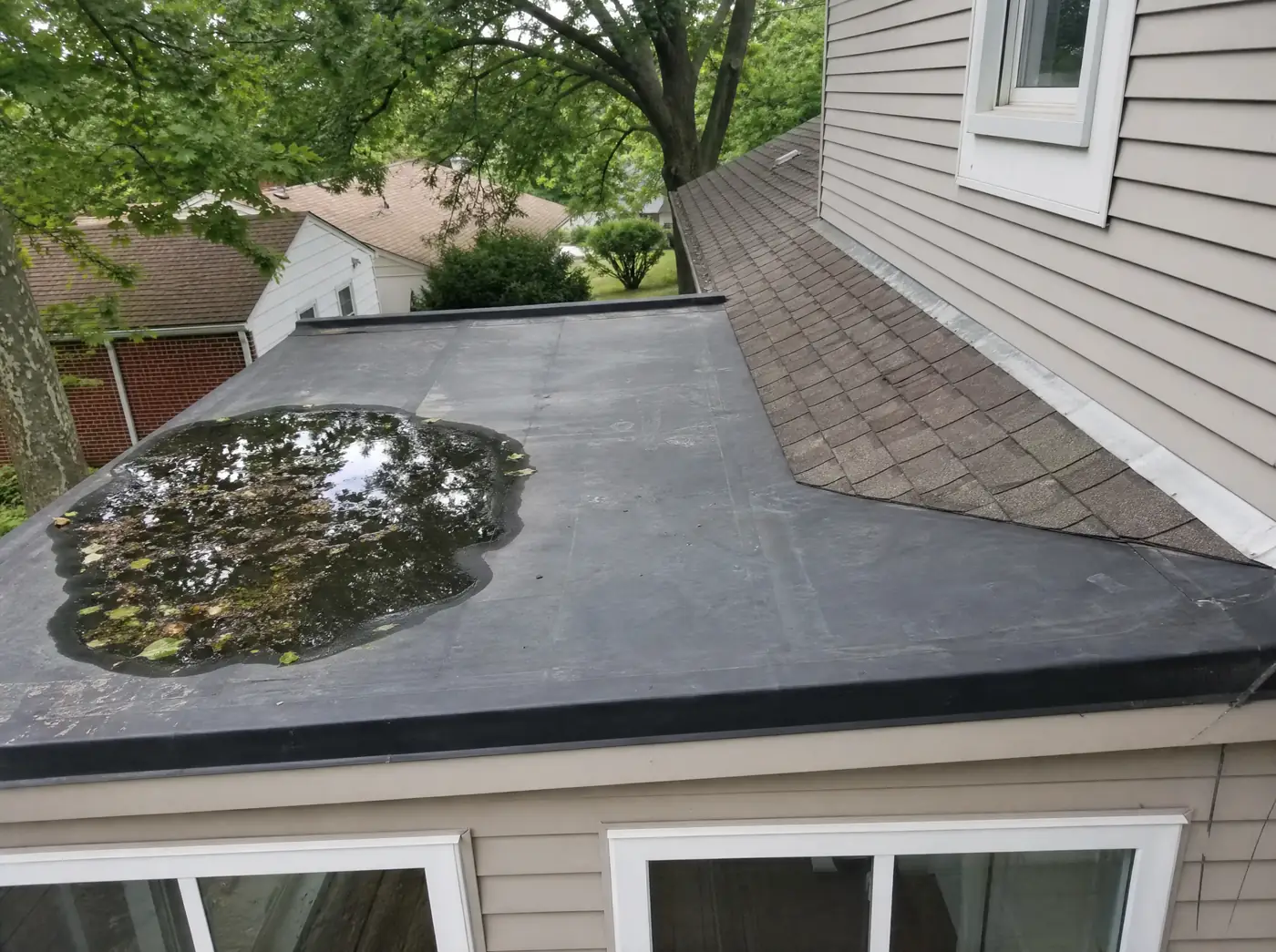
Standing water 48 hours after rain is the definition, and it is a structural or drainage problem wearing a membrane problem’s clothes. The fix is usually tapered insulation to build fall, or adding a drain or scupper, rather than patching. Ponding also multiplies UV damage, freezes and expands in a Springfield January, and adds real weight: an inch of water over a 20 by 20 foot section is about a tonne.
Seam failure
The seam is the weakest line on any membrane roof. Heat-welded TPO and PVC seams fail when they were under-welded on installation. EPDM tape seams fail with age and with movement. This is the single most common leak source we find, and it is usually a cheap fix caught early.
Flashing at walls and curbs
Where the flat meets a vertical: a house wall, a parapet, a chimney, an equipment curb. Needs proper base flashing and counterflashing let into or through the wall. Caulk is not a detail. On residential additions we find sealant smeared at that junction more often than we find flashing.
Blistering and splitting
Trapped moisture under the membrane expands in the heat and lifts it. A blister is not a leak until it splits, and then it is.
Punctures
Dropped tools, a satellite installer, hail, a branch, somebody servicing a rooftop unit without walk pads. Single-ply is tough and it is not armour.
The pitched-to-flat tie-in
The one nobody gets right. Water sheeting off a pitched roof arrives at the low-slope section with velocity and volume, and if the transition is not properly detailed with a kick-out and a membrane run up under the shingle course, it goes behind rather than over. If your leak only shows in heavy rain and only from one direction, look here.
| Work | Typical Springfield range | What moves it |
|---|---|---|
| Seam or flashing repair | $400 – $1,200 | Access and length |
| Puncture or blister repair | $300 – $700 | Cheap if caught early |
| Pitched-to-flat tie-in, redone properly | $800 – $2,400 | The one that keeps coming back |
| EPDM replacement, residential section | $7 – $12 per sq ft | Tear-off included |
| TPO replacement, residential section | $8 – $13 per sq ft | |
| Silicone coating over a sound membrane | $3 – $6 per sq ft | Only if it is dry underneath |
| Tapered insulation to fix ponding | $3 – $7 per sq ft | The actual fix, not a patch |
Residential low-slope sections are small, so the minimum call-out often dominates the price on a tiny repair. Worth bundling with anything else you need doing.
What we install on low-slope work
- EPDM rubber. The workhorse for a residential flat section. Available in a single sheet with no field seams on anything under about 20 by 25 feet, which removes the most common failure point entirely.
- TPO. White, reflective, heat-welded. Cooler in summer and the seams are stronger than tape, at the cost of needing a competent welder.
- Modified bitumen. Self-adhered or torch-applied, tough underfoot, good for a porch or deck roof that gets walked on.
- Liquid-applied and silicone coating. Seamless, goes over an existing sound membrane, excellent for awkward shapes and lots of penetrations. Only over a dry roof.
- Tapered insulation. Not a membrane, the actual fix for ponding. Built up in layers to create fall toward the drainage.
- Standing seam metal at 1:12 and up. Mechanically seamed systems will go surprisingly low and are worth considering on a visible porch roof.
What we will not do is put roll roofing or a bucket of asphalt cement over a failing low-slope section and call it repaired. It is cheap, it fails within two years, and it makes the eventual proper repair harder because everything has to come off first.
Keeping a flat roof alive
Low-slope roofs need looking at, and unlike a shingle roof they will not warn you from the street. Twice a year, plus after any big storm: clear the drains, scuppers and gutters, get the leaves and seed pods off, check the seams and every flashing junction, look for punctures around anything anybody has been working on, and note where water is still sitting two days after rain. Fifteen minutes twice a year is the difference between a $500 seam repair and a $9,000 tear-off with wet insulation to dispose of.
We do this work outside Springfield too
Same crews, same trucks, same price book. Pick your town and we will tell you what the April 28, 2026 storm actually did there.
- Republic Flat & Low-Slope Roofs
- Flat & Low-Slope Roofs in Willard
- Flat & Low-Slope Roofs for Aurora homes
- Battlefield Flat & Low-Slope Roofs
- Flat & Low-Slope Roofs in Ash Grove
- Flat & Low-Slope Roofs for Clever homes
- Fair Grove Flat & Low-Slope Roofs
- Flat & Low-Slope Roofs in Nixa
- Flat & Low-Slope Roofs for Ozark homes
- Marshfield Flat & Low-Slope Roofs
- Flat & Low-Slope Roofs in Rogersville
- Flat & Low-Slope Roofs for Strafford homes
- Bolivar Flat & Low-Slope Roofs
- Flat & Low-Slope Roofs in Branson
Questions about flat & low-slope roofs
How long does a flat roof last here?
20 to 30 years for EPDM or TPO installed and maintained properly. Ten to fifteen for one that nobody clears the drains on. On residential sections the limiting factor is almost always the flashing at the wall junction rather than the membrane itself.
Is ponding water actually a problem?
Yes, and the manufacturers agree: most single-ply warranties are void where water ponds beyond 48 hours. It multiplies UV damage, freezes and expands in winter, adds real weight, and every bit of dirt in it settles into a mat that holds it there longer.
Can you fix it or does the whole thing need replacing?
Usually fix. A membrane roof is repairable in a way a brittle shingle roof is not, and a seam or a puncture is a genuinely small job. What forces replacement is wet insulation under the membrane, because you cannot dry it in place and coating over it just seals the problem in.
Why does my sunroom only leak in heavy rain from the south?
Almost certainly the tie-in where the low-slope meets the pitched roof, and the wind is driving water behind a transition that has no kick-out flashing. It is a classic and it is fixable.
Related work we do
- Commercial & Industrial Roofing
- Roof Repair & Leak Repair
- Roof Maintenance & Coatings
- Emergency Roof Repair & Tarping
Or start at the Springfield roofing contractors homepage if you are still working out what you need.