
The statute nobody mentions: RSMo 407.725
Missouri passed this in 2011 and tightened it in 2014, specifically because of storm-chasing roofers. It is short, it is public, and you can read the whole thing on the Missouri Revisor of Statutes site. Four things in it matter to you.
1. Your roofer cannot pay or rebate your deductible. At all.
Subsection 2 bars a contractor from advertising or promising to pay or rebate any portion of your insurance deductible, and it closes the obvious loopholes by defining that to include "any allowance or offering any discount against the fees to be charged or paying the insured or any person directly or indirectly associated with the property any form of compensation, gift, prize, bonus, coupon, credit, referral fee, or other item of monetary value for any reason". So the $1,000 "storm credit", the "we’ll waive it" handshake and the gift card are all the same illegal offer. A violation is an unfair practice under the Missouri Merchandising Practices Act.
2. Your roofer cannot negotiate your claim for you
Subsection 6, verbatim in effect: a contractor shall not represent or negotiate, or offer or advertise to represent or negotiate, on behalf of a property owner on any insurance claim for roof or exterior work. Read a few Springfield roofing websites and count how many advertise exactly that. "We handle your claim from start to finish" describes conduct the statute prohibits.
3. You get a five business day cancellation right
Subsection 3: if you have signed a contract to be paid out of an insurance claim and your insurer then tells you in writing that all or part of it is not covered, you may cancel until midnight on the fifth business day after you receive that notice. Written notice to the contractor at the address in the contract is enough, and it does not have to take any particular form. If you have paid a deposit, they have ten days to return it, minus the reasonable value of genuine emergency work you acknowledged in writing.
4. That right has to be printed in your contract, twice
Subsection 4 requires the contractor to give you the cancellation statement in bold type at ten point minimum and a fully completed, duplicate, easily detachable form captioned "NOTICE OF CANCELLATION" attached to the contract. If the contract in front of you does not have that detachable form, the contractor is not compliant with Missouri law, and you should be asking what else they have not bothered with.
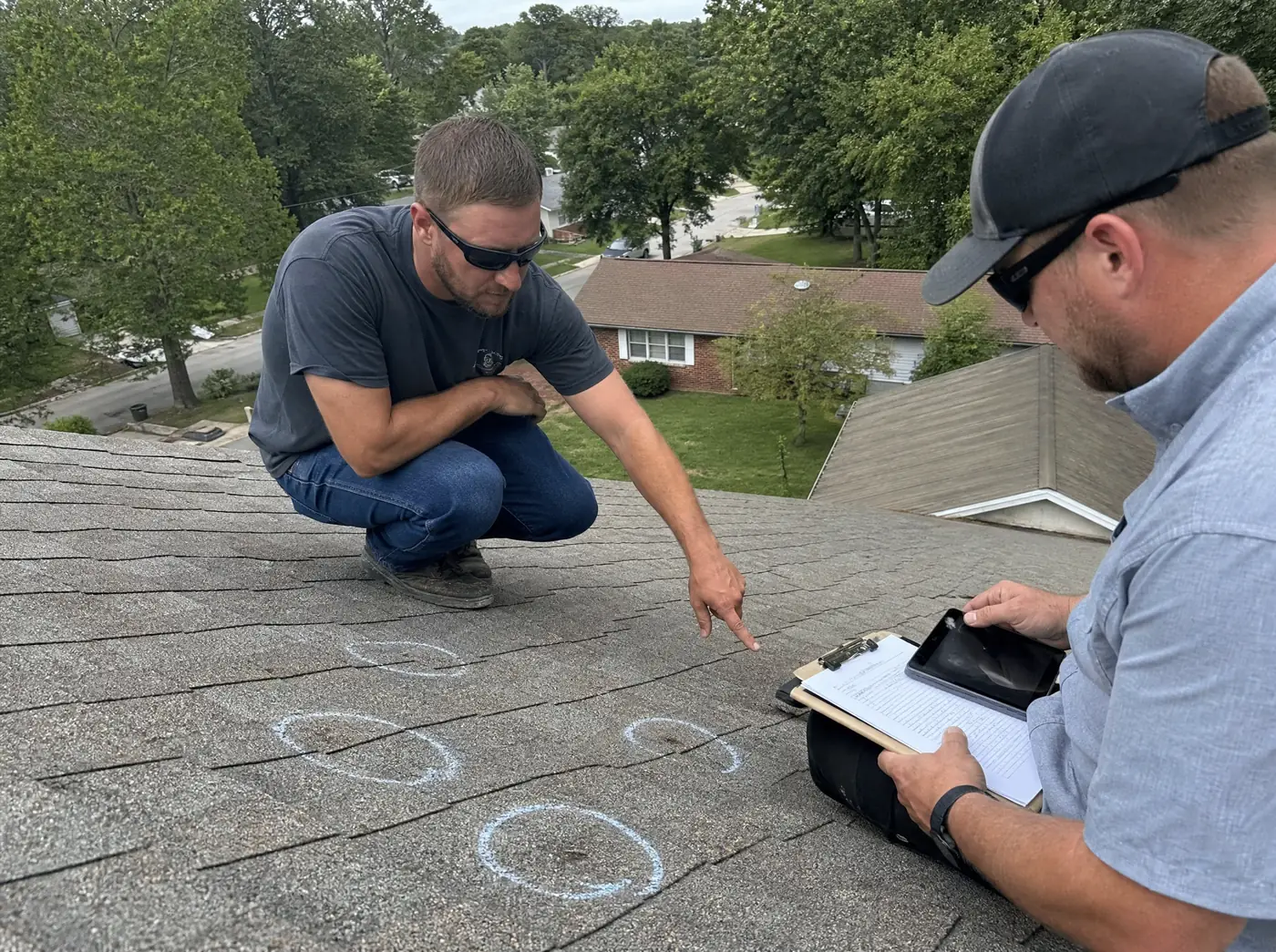
The part that actually decides claims. We inspect and document the damage to the standard an adjuster works to, we write a line-item scope in the format they use, we are physically on the roof with the adjuster so nothing gets missed on a slope nobody climbed, and we explain your policy mechanics to you so you can make your own decisions. You talk to your insurer. That is not a weaker service, it is the legal version of the same one.
The deductible surprise: percentage, not dollars
This is the single most common shock in a Springfield hail claim and it happens at the worst possible moment. A lot of Missouri carriers have quietly moved wind and hail onto a percentage deductible, calculated on your dwelling coverage limit rather than on the claim. It is one line on your declarations page.
| Work | Typical Springfield range | What moves it |
|---|---|---|
| 1% on a $200,000 dwelling limit | $2,000 | Not the $1,000 you remember |
| 1% on a $300,000 dwelling limit | $3,000 | |
| 2% on a $300,000 dwelling limit | $6,000 | Common on newer Missouri policies |
| 2% on a $450,000 dwelling limit | $9,000 | Larger homes, larger surprise |
| 5% on a $300,000 dwelling limit | $15,000 | Rare, but it exists in hail markets |
Your dwelling limit is Coverage A on the declarations page. It is not your purchase price and it is not your market value.
Check yours before you decide to file, not after. On a marginal Ozark or Rogersville claim the deductible can comfortably exceed the repair, and a claim filed and closed for nothing is worse than no claim at all.
ACV, RCV and the second cheque nobody expects
Two policy types, and which one you have changes the arithmetic completely.
- Replacement cost value (RCV). Most modern Missouri policies. The insurer pays what the roof is worth today first, holding back the difference between that and full replacement cost. That holdback is your recoverable depreciation, and it is released as a second payment after the work is done and we submit a certificate of completion. You end up out of pocket for your deductible and nothing else.
- Actual cash value (ACV). The insurer pays the depreciated value, full stop. There is no second cheque. On a 20-year-old roof this can settle for a third of what the replacement costs, and the gap is yours.
This is why taking the money and not doing the work is usually a bad trade on an RCV policy: you keep the smaller cheque and forfeit the larger one.
What to do, in order, after a storm
- 1
Document before anybody touches anything
Photograph the hail on the ground with something for scale, the dented gutters, the AC fins, the debris. Timestamped phone photos are fine and they are evidence.
- 2
Get an independent inspection
Ours is free and you keep the report. Do this before you file, so you know whether you have a claim rather than finding out from an adjuster.
- 3
Read your declarations page
Find the wind and hail deductible and work out the actual dollar figure. Find whether you are RCV or ACV. Both are on one page.
- 4
File it yourself
Directly with your carrier. Not through a contractor, because Missouri does not allow them to do it for you.
- 5
Have us on the roof for the adjuster meeting
We point at what we found and hand over the documentation. The adjuster makes their own call. Slopes that nobody walks are slopes that do not get paid for.
- 6
Compare the adjuster’s scope to ours line by line
Where something has been missed, that is a supplement, and it is submitted with photographs and measurements rather than argued about. Missed drip edge, ice-and-water, ridge vent and starter course are the usual four.
Read the contract before you sign it
Post-storm contracts are where people get caught, and usually by a clause rather than a price.
- "Contingency agreement" that binds you to the contractor as soon as the claim is approved, with a cancellation fee if you walk. Your statutory five-day right survives, but only in the specific circumstance the statute describes.
- An assignment of benefits clause handing your claim proceeds directly to the contractor. Read very carefully before signing anything that does this.
- No detachable NOTICE OF CANCELLATION form. Required by statute on insurance-funded work. Its absence is a compliance failure.
- "Insurance approved amount" as the price, with no scope and no numbers. You are signing a blank cheque made out to whatever the adjuster writes.
- A deposit over about a third before any material is on site.
We do this work outside Springfield too
Same crews, same trucks, same price book. Pick your town and we will tell you what the April 28, 2026 storm actually did there.
- Republic Insurance Claims
- Insurance Claims in Willard
- Insurance Claims for Aurora homes
- Battlefield Insurance Claims
- Insurance Claims in Ash Grove
- Insurance Claims for Clever homes
- Fair Grove Insurance Claims
- Insurance Claims in Nixa
- Insurance Claims for Ozark homes
- Marshfield Insurance Claims
- Insurance Claims in Rogersville
- Insurance Claims for Strafford homes
- Bolivar Insurance Claims
- Insurance Claims in Branson
Questions about insurance claims
Can you just deal with my insurance company for me?
No, and neither can anyone else in Missouri. RSMo 407.725 subsection 6 prohibits a roofing contractor from representing or negotiating on your behalf on an insurance claim. What we can do is document, scope, and stand on the roof with the adjuster, and that is where most claims are actually won or lost.
Somebody offered to cover my deductible. Is that a good deal?
It is an illegal one. That is not a technicality either: it means either they are inflating the scope to your insurer to cover it, or they are cutting something out of your roof to pay for it. Both are being done with your money.
What if my claim gets denied?
You can request a re-inspection, and it is reasonable to ask for a different adjuster if the first one did not walk every slope. Bring the documentation. If the denial is correct, which it often is in the lower-hail areas south of Springfield, then we talk about the roof on its own merits instead.
Do I have to use the contractor my insurer recommends?
No. Preferred-vendor programmes are a convenience for the insurer, not an obligation for you. Get a couple of independent numbers.
How long does the whole claim take?
Straightforward claims after April have been running six to ten weeks from filing to work starting. Disputed ones are going three to six months. The adjuster queue, not the roofing crews, is the bottleneck at the moment.
What is a supplement?
A request to the insurer to add something the original scope missed, submitted with photographs and measurements. It is routine and unglamorous. Drip edge, ice-and-water shield, starter course and ridge vent are the four that get left off most often.
Related work we do
- Storm & Hail Damage Roof Repair
- Roof Replacement & Tear-Off
- Roof Inspection & Written Estimate
- Emergency Roof Repair & Tarping
Or start at the Springfield roofing contractors homepage if you are still working out what you need.