
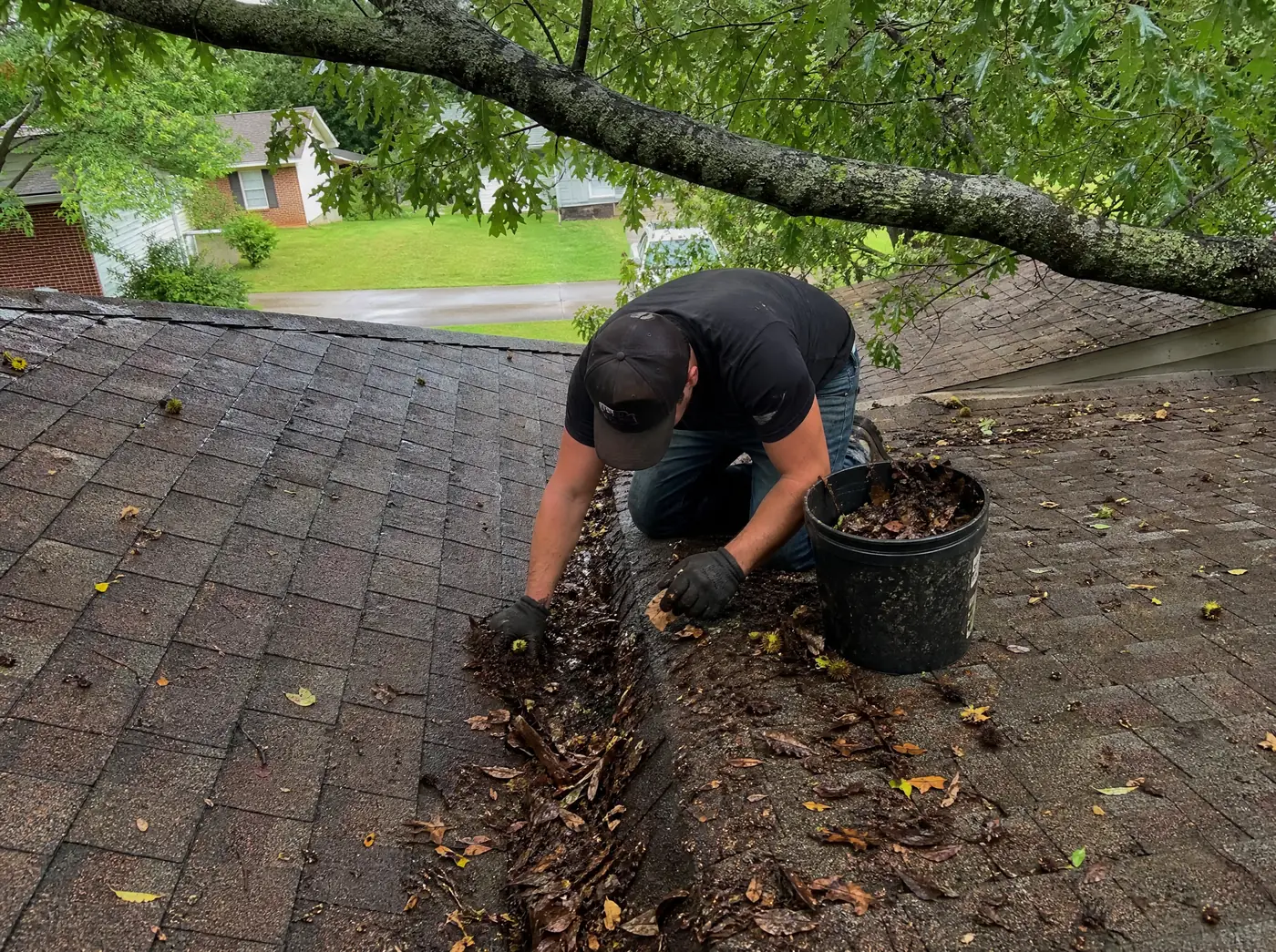
A pipe boot costs about two hundred dollars to replace before it leaks. The same boot, found two winters later, has cost you a stained ceiling, wet insulation, four sheets of decking and a conversation with your insurer about whether long-term water damage is covered, which it usually is not. That gap is the entire argument for maintenance and there is not much more to it than that.
What an annual maintenance visit covers
- Every slope walked, field condition assessed, and photographs compared against last year so you can see the rate of change rather than just the state.
- All flashing checked: chimney, sidewall, headwall, valleys, drip edge, apron.
- Every penetration: pipe boots, flue caps, bath fan terminations, skylights, satellite and solar mounts.
- Sealant renewed where it has cracked, at every mount and termination.
- Ridge cap and ridge vent checked, and the exhaust confirmed as actually working.
- Gutters and downspouts cleared, and the discharge points checked.
- Debris off the roof: leaves and seed pods out of valleys and behind chimneys, where a dam of wet leaves holds water against the shingles all winter.
- Overhanging limbs noted, because branches abrade shingles in wind and drop the debris that causes the dams.
- Attic look where there is access: new staining, damp, blocked baffles.
- A short written report with the photographs, and a plain list of anything that needs doing, with prices.
Roughly ninety minutes. Nothing found means you get an email saying nothing was found.
| Work | Typical Springfield range | What moves it |
|---|---|---|
| Annual residential maintenance visit | $250 – $450 | Report, photographs, sealant renewal, gutters cleared |
| Commercial maintenance programme | By quote, usually twice yearly | Priced per building |
| Roof and gutter debris clearing | $150 – $350 | |
| Sealant and flashing service | $200 – $600 | Renewing what has cracked |
| Silicone coating restoration | $3 – $6 per sq ft | Only over a dry, sound membrane |
| Acrylic coating | $2.50 – $5 per sq ft | Cheaper, less ponding-tolerant |
| Asphalt shingle rejuvenation treatment | $0.90 – $1.80 per sq ft | Only useful in a narrow age window |
A maintenance visit costs roughly what one emergency call-out does, and it is the difference between finding a problem in March and finding it in your ceiling.
Roof restoration and coatings
Not everything with a tired roof needs a tear-off. On low-slope and commercial membranes, a silicone or acrylic coating over a sound but ageing surface produces a seamless, reflective, watertight layer and can add ten to fifteen years for a fraction of a replacement. It is also frequently treated as maintenance rather than capital expenditure, which your finance department may care about more than you do.
The conditions matter, and we will not pretend otherwise:
- The existing roof must be dry. Wet insulation under the membrane cannot be dried in place, and coating over it seals the water in and buys you a slower, more expensive failure. We core it and find out rather than assuming.
- The substrate must be sound. Coating is a surface treatment, not a structural one.
- It has to be prepared properly. Cleaned, seams reinforced, penetrations detailed. A coating sprayed over a dirty roof peels.
On residential asphalt, you will see rejuvenation products advertised, the soy-oil sprays that promise to add five years to an ageing shingle roof. The chemistry is real, it restores flexibility to the asphalt, and it works best on roofs that are ageing but not yet failing. It will do nothing for hail bruising, nothing for granule loss down to the mat, and nothing for a roof that is already leaking. We will tell you honestly whether your roof is in the window where it helps, and most of the roofs people ask us about are past it.
A Springfield roof calendar
Late winter, February to March
Check for winter damage before the severe season starts. Ice damage at the eaves, wind damage from the January fronts, and anything the freeze-thaw has opened up at a flashing.
Spring, April to June
The severe window. Greene County’s hail concentration is right here, as April 28 made vividly clear. After any hail or wind event over about 50 mph, get it looked at, and photograph the ground-level evidence the same day.
Autumn, October to November
Clear the gutters and the valleys, twice if you are under oaks, because oaks drop last and after everybody has already cleaned. Check the flashing and sealant before the freeze-thaw season.
Winter, December to February
Watch for ice along the eave line, which is a ventilation message rather than a weather one. On heavy wet snow, low-slope and porch roofs are the load concern, not the main roof.
Things worth doing yourself, and one that is not
Keep the gutters clear. Get leaves out of the valleys with a soft brush from a ladder if you are comfortable on one. Trim back branches that touch the roof. Look at your ceilings after heavy rain. Check the attic twice a year with a torch.
What is not worth doing yourself is pressure washing an asphalt roof. It strips the granules, which are the only thing protecting the mat from ultraviolet, and it takes years off the roof in an afternoon. If the black streaking bothers you, a low-pressure treatment or a zinc strip at the ridge is the answer.
We do this work outside Springfield too
Same crews, same trucks, same price book. Pick your town and we will tell you what the April 28, 2026 storm actually did there.
- Republic Roof Maintenance
- Roof Maintenance in Willard
- Roof Maintenance for Aurora homes
- Battlefield Roof Maintenance
- Roof Maintenance in Ash Grove
- Roof Maintenance for Clever homes
- Fair Grove Roof Maintenance
- Roof Maintenance in Nixa
- Roof Maintenance for Ozark homes
- Marshfield Roof Maintenance
- Roof Maintenance in Rogersville
- Roof Maintenance for Strafford homes
- Bolivar Roof Maintenance
- Roof Maintenance in Branson
Questions about roof maintenance
How often should a roof be looked at?
Once a year for a roof under fifteen, twice for one over fifteen or with a lot of trees over it, and always after a hail or high-wind event. Commercial low-slope is twice a year minimum because you cannot see anything from the ground.
Does maintenance keep my warranty valid?
It helps, and on commercial systems it is often an explicit condition of the manufacturer warranty. On residential, the two things that most commonly void a manufacturer warranty are inadequate ventilation and improper installation, neither of which maintenance fixes retroactively, though an annual visit is how you find out you have a problem while it is still fixable.
Is roof rejuvenation actually worth it?
Sometimes, in a narrow window. On an asphalt roof that is ageing and drying out but not yet failing, restoring flexibility to the asphalt genuinely helps. On a roof with hail bruising, general granule loss or an active leak, it is money away. We will tell you which one you have and it is often not the answer people were hoping for.
Can you take snow off my roof?
We can, and we mostly advise against doing it yourself, because raking a roof damages shingles and people fall. Springfield rarely gets enough snow to matter structurally on a pitched roof. Low-slope sections, carports and porch roofs under heavy wet snow are the real concern.
Do you offer a maintenance plan for rental properties?
Yes, and it is one of the more sensible things a landlord can spend money on. Priced per property with a portfolio rate, one visit a year, and a written report per address so you have documentation if a tenant claim ever comes up.
Related work we do
- Roof Inspection & Written Estimate
- Commercial & Industrial Roofing
- Gutters, Soffit & Fascia
- Roof Repair & Leak Repair
Or start at the Springfield roofing contractors homepage if you are still working out what you need.