
This is the least interesting page on this site and quite possibly the most useful one. Almost nobody rings a roofer about ventilation. Almost every prematurely failed roof we tear off in this town had a ventilation problem, and the owner had no idea, and the manufacturer would have declined the warranty claim on exactly those grounds.
What bad ventilation does to a Springfield roof
A sealed attic under a Missouri July sun runs 140 to 160 degrees. The underside of your shingles sits in that all day. Asphalt ages by losing its volatile oils, heat drives that, and the shingle becomes brittle years ahead of schedule. A roof rated for twenty-two years finishes at fourteen and nobody ever connects the two.
The winter version is quieter and worse. Warm moist air from the house rises into a cold attic, hits the underside of the deck, and condenses. Enough cycles of that and the decking delaminates, the insulation mats down and stops working, and mould grows on the rafters. People find it when they are up there looking for something else.
And a warm attic in January is how you get ice at the eaves: heat escaping through the roof melts snow high up, the meltwater runs down to the cold overhang, refreezes, and backs water up under the shingles. We do not get a great deal of snow here, but we get enough freeze-thaw for this to be a real Springfield failure mode.
How ventilation actually works: intake and exhaust, balanced
Air has to come in low and leave high. Miss either half and it does not move.
- Intake at the soffit. Continuous perforated soffit panel or individual vents along the eave. This is the half that is nearly always the problem.
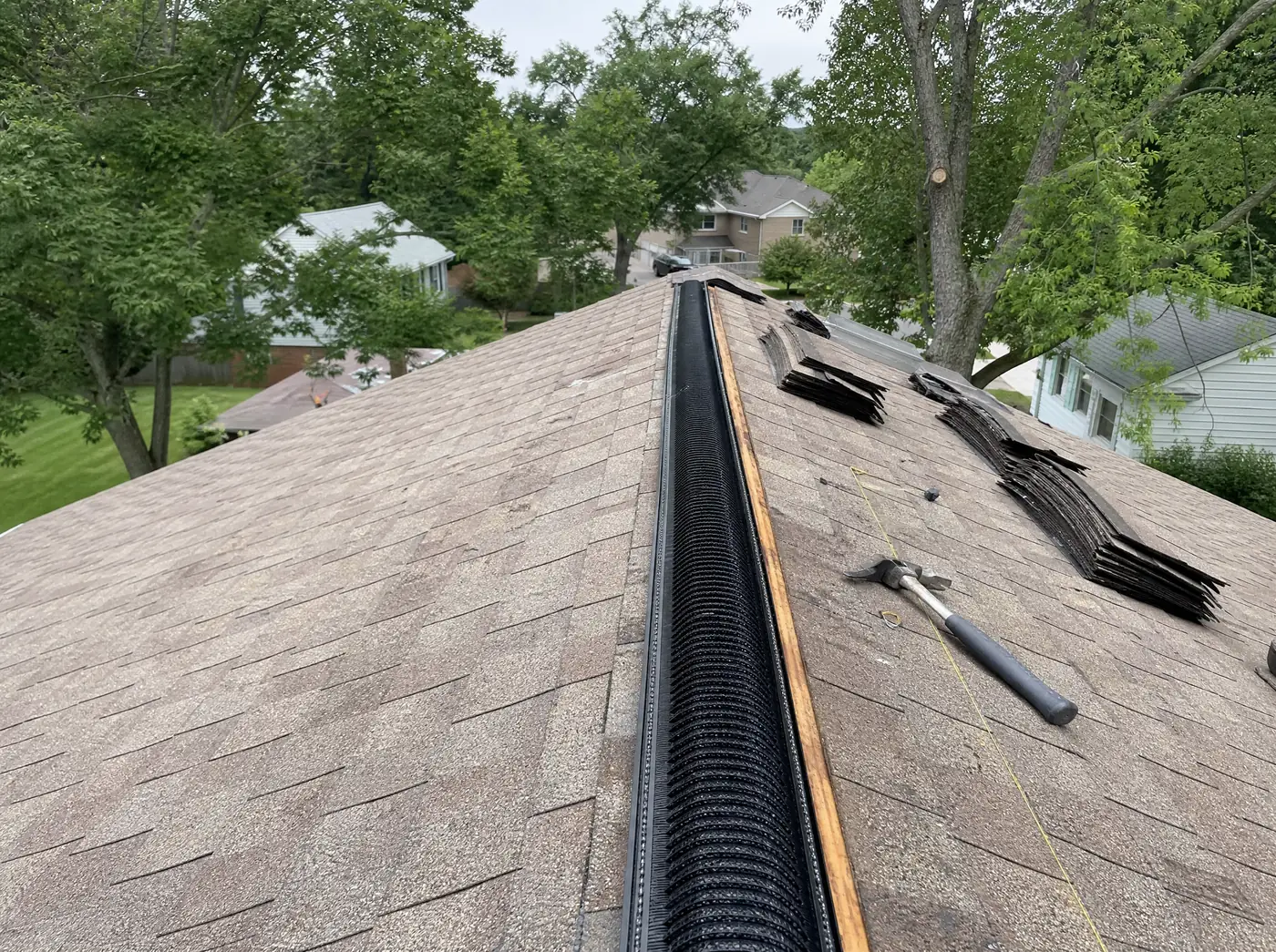
- Exhaust at the ridge. A continuous ridge vent cut into the peak and covered by the ridge cap. Uses the stack effect, has no moving parts, and is invisible from the street.
- Roughly 1:1. Intake area should at least equal exhaust area, and if anything exceed it. Get that backwards and the ridge vent pulls air from inside the house through your ceiling instead of from the soffit.
- The rule of thumb: one square foot of net free ventilating area per 150 square feet of attic floor, halved to 1:300 with a vapour barrier, split evenly high and low.
The single most common fault we find in Springfield attics: a perfectly good ridge vent with the soffit intake completely blocked. Insulation shoved into the eave when somebody blew in more R-value, or a perforated soffit panel painted solid, or baffles that were never installed. The homeowner paid for ventilation and has none. It is usually a couple of hours with baffles to fix and it is the best money on the whole job.
The exhaust options, ranked
- Continuous ridge vent. Best for almost every Springfield house with a decent ridge run. Even, passive, invisible.
- Box vents. The static squares near the ridge. Fine, less effective than continuous, useful on hipped roofs with very little ridge.
- Powered attic fans. We mostly advise against them. They work, and in a house with inadequate intake they will happily pull conditioned air out of your living space through ceiling gaps, so you are air-conditioning the attic. Fix the intake instead.
- Solar attic fans. Same objection, no running cost.
- Turbine (whirlybird) vents. Effective when spinning, and the bearings are a maintenance item that eventually seizes and squeals.
- Gable vents. Common on older Springfield houses. They short-circuit a ridge and soffit system by giving the air an easier path, so if we cut a ridge vent we normally block the gables.
One rule regardless: do not mix exhaust types on the same attic space. A ridge vent plus box vents plus a gable vent means the high vents pull air from the low vents instead of from the soffit, and a section of your attic gets no flow at all.
Underlayment, because it lives on the same job
Underlayment is the membrane between the shingles and the deck, and it is what keeps water out on the day a shingle fails. It is invisible, it is cheap, and it is the second place after flashing where a low bid saves its money.
- Synthetic underlayment across the whole field. Lighter, far stronger than felt, will not tear when a crew walks it, and it does not wrinkle when it gets damp during the install. Felt is what you use if you are trying to hit a number.
- Ice-and-water shield at the eaves, in every valley, and around every penetration. Self-adhering, seals around nail shanks. This is the layer that saves the ceiling.
- High-temperature underlayment under metal, because the cavity under a metal panel gets hot enough to soften a standard membrane.
- Drip edge at eaves and rakes, under the underlayment at the rake and over it at the eave. Required, cheap, and skipped constantly.
| Work | Typical Springfield range | What moves it |
|---|---|---|
| Continuous ridge vent, cut and installed | $8 – $16 per linear ft | Cheap as part of a reroof |
| Box vents | $150 – $300 each | Installed |
| Soffit intake vents added | $45 – $110 each | |
| Attic baffles at the eave | $4 – $9 each | The fix for blocked intake |
| Bath fan re-ducted to outside | $250 – $600 | Should not vent into the attic |
| Synthetic underlayment | Included in our replacement scope | Not felt |
| Ice-and-water shield, eaves and valleys | Included in our replacement scope | |
| Attic ventilation assessment | Free with any inspection |
Ventilation work done during a reroof costs a fraction of what it costs as a standalone visit, because the roof is already open.
What we check on every inspection
It takes five minutes and it is free.
- Whether there is any exhaust at the ridge at all. Plenty of pre-1980 Springfield houses have none.
- Whether the soffit is genuinely open, by looking from inside the attic rather than from the ground.
- Baffles at the eave keeping insulation out of the airway.
- Mixed exhaust types fighting each other.
- Bathroom and kitchen fans venting outside rather than into the attic. About one house in six around here fails this one.
- Staining, rusted nail shanks or mould on the decking underside, which is condensation history.
- Insulation depth and whether it has matted down, because wet insulation stops insulating.
We do this work outside Springfield too
Same crews, same trucks, same price book. Pick your town and we will tell you what the April 28, 2026 storm actually did there.
- Republic Ventilation & Underlayment
- Ventilation & Underlayment in Willard
- Ventilation & Underlayment for Aurora homes
- Battlefield Ventilation & Underlayment
- Ventilation & Underlayment in Ash Grove
- Ventilation & Underlayment for Clever homes
- Fair Grove Ventilation & Underlayment
- Ventilation & Underlayment in Nixa
- Ventilation & Underlayment for Ozark homes
- Marshfield Ventilation & Underlayment
- Ventilation & Underlayment in Rogersville
- Ventilation & Underlayment for Strafford homes
- Bolivar Ventilation & Underlayment
- Ventilation & Underlayment in Branson
Questions about ventilation & underlayment
How do I know if my attic ventilation is bad?
Go up there on a hot afternoon. If it is dramatically hotter than outside and the air is dead still, you have a problem. In winter, look for damp or frost on the underside of the deck and rust on the nail shanks. From outside, ice along the eave in January and a roof that is ageing faster than the neighbours’ are both tells.
Will more ventilation lower my cooling bill?
A little, and it is not the main reason to do it. A cooler attic reduces heat transfer through the ceiling, so there is a real if modest saving. The reason to do it is that it adds years to the roof and keeps the manufacturer warranty valid.
Should I put in a powered attic fan?
Usually not. In a house with inadequate soffit intake a powered fan pulls conditioned air out of your living space through ceiling penetrations, so you pay to air-condition the attic. Fix the intake and put in a ridge vent instead. Cheaper, passive, nothing to fail.
Is ice-and-water shield really necessary in Missouri?
At the eaves and in the valleys, yes. We do not have Minnesota winters and we do have plenty of freeze-thaw cycling, and the valleys carry the most water on any roof regardless of climate. It is a small share of the job cost and it is the layer that protects the ceiling.
My roof is only twelve years old and it looks finished. Why?
Ventilation is the first thing we would look at, followed by whether it was an overlay. A shingle cooked from underneath for twelve Missouri summers ages like a twenty year old one, and the manufacturer will point at the attic if you make a warranty claim.
Related work we do
- Roof Replacement & Tear-Off
- Asphalt Shingle Roofing
- Gutters, Soffit & Fascia
- Roof Maintenance & Coatings
Or start at the Springfield roofing contractors homepage if you are still working out what you need.